
|
|
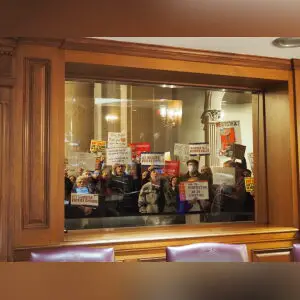
Hoosiers rally against proposed mid-census congressional redistricting on Monday, Dec. 1, 2025, outside the House chamber at the Indiana Statehouse. Photo by Leslie Bonilla Muñiz/Indiana Capital Chronicle
Millions of Hoosiers would have different representation in the U.S. House under a proposed redrawing of Indiana’s congressional maps that aims to produce a 9-0 GOP delegation.
Indiana House Republicans released their redistricting plan Monday, just hours before the start of a one-week fast-track process toward that chamber granting President Donald Trump’s demand to create more GOP-friendly districts ahead of the 2026 elections.
A court challenge is anticipated if a redistricting plan is adopted. But provisions in the redistricting legislation, House Bill 1032, also would prevent county-level judges from blocking new congressional maps and direct any appeals immediately to the Indiana Supreme Court.
The House Elections and Apportionment Committee is scheduled to hold a public hearing beginning at 9 a.m. Tuesday on the redistricting bill. The hearing is set for the House chamber and to end no later than 2:45 p.m.
The online form to sign up to testify in person is available beginning at midnight Tuesday.
Passage of the redistricting plan isn’t assured because of persistent resistance from several Republican state senators. Several of those senators have cited widespread voter opposition to changing the current GOP-drawn maps adopted in 2021 that have seen Republicans maintain a 7-2 Indiana congressional majority.
Republican House Speaker Todd Huston acknowledged the political motivations behind the proposed new map, which splits strongly Democratic Indianapolis among four districts that all stretch far into rural, heavily Republican counties.
“We’ve always had districts that span hundreds of miles,” Huston told reporters. “The maps were put together with the interest of trying to create as many Republican seats as possible.”
Proposed maps overhaul all 9 districts
Linda Butler of Lawrence in northeastern Marion County was among a few hundred protesters at a Monday anti-redistricting rally inside the Statehouse.
Butler criticized the proposed map for obliterating the current 7th District, where she lives. It is currently held by Democratic Rep. André Carson. The proposal would put her home in a new 7th District, spanning from the north side of Indianapolis to the Ohio River near Cincinnati.
“They’re doing it so that they can win elections,” Butler said of Republicans. “It is terrible. I think it’s terrible. That’s an illustration for me that this is wrong.”
The proposed map drastically overhauls all nine Indiana congressional districts, but Huston said he did not know how many people would be in different districts.
For instance, the 9th District now held by Republican Rep. Erin Houchin, who is from rural southern Indiana’s Washington County, would lose its southeastern Indiana counties near Cincinnati. The revamped district would span from near downtown Indianapolis to the Ohio River counties just north of Louisville, Kentucky.
State Rep. Wendy Dant Chesser, D-Jeffersonville, called the proposal “completely unfair to residents of Southern Indiana.”
“We’re impacted more by Louisville than by Indianapolis,” Dant Cheser said. “It’s not the same for Central Indiana. Our representative in Congress will have split loyalties between two major metropolitan areas with two very different needs.”
It was uncertain from the proposed map released Monday whether the Indianapolis home of Carson, the Democratic congressman, was placed in a district with Houchin or Republican Rep. Jefferson Shreve of Indianapolis.
“Splicing our state’s largest city — and its biggest economic driver — into four parts is ridiculous,” Carson said in a statement. “It’s clear these orders are coming from Washington, and they clearly don’t know the first thing about our community.”
The Lake Michigan shoreline area that now makes up the 1st District held by Democratic Rep. Frank Mrvan would be split in two by the new map.
Republicans propose a new 1st District taking in Democratic-friendly Lake County then heading southeast to take in the areas around the small cities of Logansport, Peru and Wabash.
Political breakdown of proposed maps
Trump won each of the districts under the proposed map by at least 12 percentage points in the 2024 election, according to an analysis by Indianapolis City-County Councilor Nick Roberts, a Democrat.
Trump’s narrowest win was in the proposed 1st District, where Republican Gov. Mike Braun won by a 6 percentage point margin, according to Roberts.
J. Miles Coleman, the associate editor of political analysis site Sabato’s Crystal Ball at the University of Virginia, predicted Democrats’ performance there would mirror broader electoral trends — such as if the 2026 midterms end up a “Democratic wave.”
“Under that logic, maybe Mrvan actually does have a decent shot of holding onto his seat,” Coleman said.
The new Indianapolis-area seats, however, would be “fairly secure,” according to Coleman: they “vote pretty much like the state as a whole,” 60-40 for Trump, when using 2024 election data.
State Rep. Earl Harris, D-East Chicago, told the anti-redistricting rally crowd that he objected to Republicans calling the Legislature back into session weeks ahead of its planned Jan. 5 return to push through redistricting.
Harris, who is chair of the Indiana Black Legislative Caucus, argued redrawing of the 1st District where he lives did not make sense and shouldn’t take priority over dealing with problems such as rising health care, utility and child care costs.
“If we come in early, we need to come in for real issues facing real Hoosiers,” Harris said.
Republicans shift on map standards
Huston acknowledged the proposed congressional map was developed in conjunction with the National Republican Redistricting Trust, which was also involved in drawing the new map adopted by Texas Republicans this summer.
While this year’s redistricting wave started in Texas, Indiana House Elections Committee Chair Tim Wesco, R-Osceola, said he supported Republicans responding to previous congressional maps drawn in Democratic-led states.
“You could trace it back to when Illinois adopted their maps years ago, and they’re ridiculous, where they eliminated three Republican seats in the 2021 redistricting,” Wesco told the Indiana Capital Chronicle.
Wesco in 2021 praised the Republican-sponsored Indiana maps for their compactness and maintaining “communities of interest.”
Asked whether those standards should still apply, Wesco replied, “The maps we adopted in 2021 were excellent maps, no doubt. But 2025 is not 2021.”
Court fight anticipated
Redistricting opponents vowed to challenge a finalized map but said they’re still tailoring their legal strategies to the draft released Monday.
“It’s a little too early to speak specifically, but I can tell you: absolutely, conversations are being had right now, and should maps be passed, they will be challenged almost immediately,” said Julia Vaughn, executive director of nonpartisan elections watchdog Common Cause Indiana.
Racial gerrymandering could be the centerpiece of a lawsuit at the federal level, but there’s also discussion of state-level legal fights, she said.
Lawmakers could be part of that fight. The Indiana Black Legislative Caucus, made up of more than a dozen Black lawmakers — all Democrats — gathered Monday afternoon to denounce the proposed districts.
“They’re racially gerrymandered. There’s no ifs, ands and buts about it,” said Rep. Cherrish Pryor, D-Indianapolis.
Language in the bill, however, would constrain challenges in state courts.
The legislation would prohibit seeking or granting temporary injunctions, which would otherwise block the map from going into effect.
Lawsuits can “disrupt the orderly conduct” of elections, the bill reads – and so can “judicial alterations.” Court action can “undermine voter confidence.”
It also mandates that the Indiana Supreme Court have “exclusive” jurisdiction over any appeal of an order promoting an injunction. Actions covered by this chunk of text “must be given priority over ordinary matters,” the bill reads.
Huston said the intent of that language is “just making sure there’s a process to get to the Supreme Court as quickly as possible. They’re the final determinant.”
Asked if the provisions could overstep separation between the three branches of government, he said, “No.”
Threats continue
Several GOP senators and Indiana Gov. Mike Braun have reported intimidation attempts, plus swatting and bomb threats. Their stances on redistricting run the gamut, from opposed to undecided to supportive.
Sen. Mike Bohacek, R-Michiana Shores, on Monday became the latest to confirm a bomb threat targeting his home. Sen. Jean Leising, R-Oldenburg, also reported a “pipe bomb threat” at her home Saturday evening.
Both Bohacek and Leising have said they are against redrawing the congressional maps.
“I will not cave” on redistricting, Leising wrote in a message to constituents. “I will be fighting for all of you in this early session!”
Map unveiled as Indiana House gets down to redistricting business
Loading Comments